The wear coefficient is a physical coefficient used to measure, characterize and correlate the wear of materials.
Background
Traditionally, the wear of materials has been characterized by weight loss and wear rate. However, studies have found that wear coefficient is more suitable. The reason being that it takes the wear rate, the applied load, and the hardness of the wear pin into account. Although, measurement variations by an order of 10-1 have been observed, the variations can be minimized if suitable precautions are taken.[1][2]
A wear volume versus distance curve can be divided into at least two regimes, the transient wear regime and the steady-state wear regime. The volume or weight loss is initially curvilinear. The wear rate per unit sliding distance in the transient wear regime decreases until it has reached a constant value in the steady-state wear regime. Hence the standard wear coefficient value obtained from a volume loss versus distance curve is a function of the sliding distance.[3]
Measurement
The steady-state wear equation was proposed as:[2]

where 


Therefore, the wear coefficient

As 


As the standard method uses the total volume loss and the total sliding distance, there is a need to define the net steady-state wear coefficient:
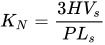
where 

With regard to the sliding wear model K can be expressed as:[4]

where 
If the coefficient of friction is defined as:[4]

where 



In an experimental situation the hardness of the uppermost layer of material in the contact may not be known with any certainty, consequently, the ratio 
Composite material
As metal matrix composite (MMC) materials have become to be used more often due to their better physical, mechanical and tribological properties compared to matrix materials it is necessary to adjust the equation.
The proposed equation is:[2]
![K={\frac {3g_{1}d(1-f_{v})}{g_{3}f_{v}L}}\left[1-exp\left({\frac {-g_{3}f_{v}L}{d(1-f_{v})}}\right)\right]](https://wikimedia.org/api/rest_v1/media/math/render/svg/e641562787b232e7e2e5bf759cedb50e22e785a0)
where 


Therefore, the effects of load and pin hardness can be shown:[2]
![K={\frac {3Hm_{A}d(1-f_{v})}{PLg_{3}f_{v}L}}\left[1-exp\left({\frac {-g_{3}f_{v}L}{d(1-f_{v})}}\right)\right]](https://wikimedia.org/api/rest_v1/media/math/render/svg/f0bb3fef2f600ddd2ea8175e65b688a072488b69)
As wear testing is a time-consuming process, it was shown to be possible to save time by using a predictable method.
| This article uses material from the Wikipedia article Metasyntactic variable, which is released under the Creative Commons Attribution-ShareAlike 3.0 Unported License. |